Net Bacon
Public toolsDNS, ICMP ping, TLS, routing, and subnet tools with results you can put in a ticket.
- Networking
- Live monitoring
- Background workers
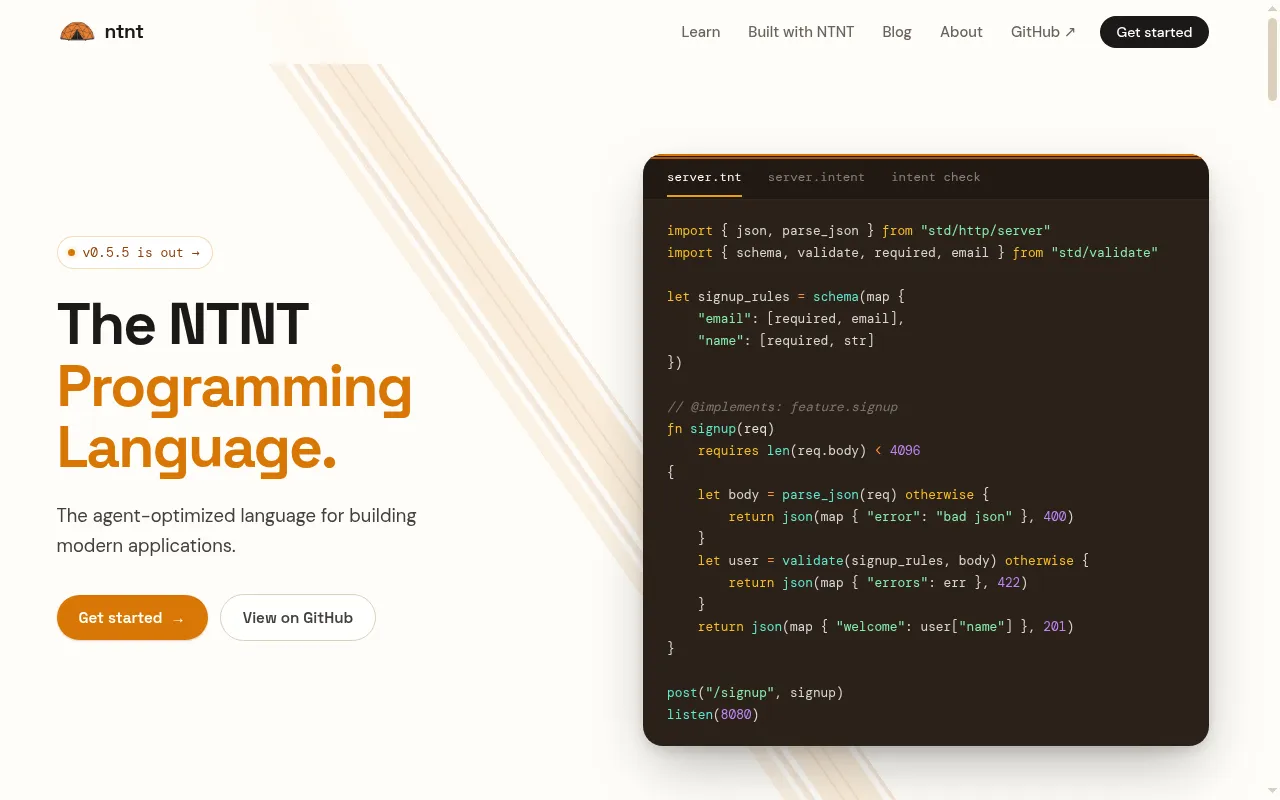
The agent-optimized language for building modern applications.
import { json, parse_json } from "std/http/server"
import { schema, validate, required, email } from "std/validate"

let signup_rules = schema(map {
    "email": [required, email],
    "name": [required, str]
})

// @implements: feature.signup
fn signup(req)
    requires len(req.body) < 4096
{
    let body = parse_json(req) otherwise {
        return json(map { "error": "bad json" }, 400)
    }
    let user = validate(signup_rules, body) otherwise {
        return json(map { "errors": err }, 422)
    }
    return json(map { "welcome": user["name"] }, 201)
}

post("/signup", signup)
listen(8080)
## Glossary

| Term                          | Means                     |
|-------------------------------|---------------------------|
| someone signs up with {body}  | POST /signup body {body}  |
| they are welcomed             | status 201                |
| they are asked to fix it      | status 422                |

---

Feature: Signup
  id: feature.signup

  Scenario: Valid details
    When someone signs up with {"email": "[email protected]", "name": "Ada"}
    → they are welcomed
    → body contains "Ada"

  Scenario: Bad email
    When someone signs up with {"email": "nope", "name": "Ada"}
    → they are asked to fix it
$ ntnt intent check server.tnt -vv

✓ Feature: Signup
  ✓ Valid details
      → they are welcomed
      → body contains "Ada"
        ✓ status: 201
        ✓ body contains "Ada"
  ✓ Bad email
      → they are asked to fix it
        ✓ status: 422

=== Summary ===
Features:   1 total, 1 passed, 0 failed
Scenarios:  2 passed, 0 failed, 0 skipped
Assertions: 3 passed, 0 failed
Every major programming language was designed for people writing code by hand. NTNT is designed for agents writing the code while people decide what it should do, so the language, the tooling, and the standard library are all built around how an agent works.
ntnt learn writes setup files for Claude Code, Cursor, Codex, and Copilot, and ntnt docs answers any question about a function from the terminal. Your agent doesn’t need NTNT in its training data.ntnt intent check runs them against the real code after every change. ntnt lint and ntnt validate report errors as JSON, and ntnt inspect lists every route, function, and contract. The server hot-reloads, so each change is checked in seconds.NTNT_TYPE_MODE sets how strictly types are checked at runtime and NTNT_LINT_MODE sets how strictly they’re checked before it runs, so a prototype and a production app can use the same code. Errors are Result values, handled with ? or otherwise instead of slipping past, and requires and ensures report the values that broke them. In a route, a failed requires returns a 400.fetch blocks private network addresses, responses get security headers, and std/secrets keeps credentials out of logs and pages.Applications running on NTNT in production today.
DNS, ICMP ping, TLS, routing, and subnet tools with results you can put in a ticket.
The site you're reading: documentation, a PostgreSQL-backed blog, and this showcase.

Infrastructure monitoring with scheduled network checks and authenticated access.
Describe what the app should do in plain sentences, and NTNT turns them into tests. Scenarios are written in the Intent Assertion Language (IAL), where a glossary maps each phrase to a concrete check against routes, responses, or functions. Contracts check the code from the inside: requires and ensures state what each function accepts and returns, and fail with the values that broke them. Your agent writes both from your request, runs them after every change, and fixes what fails.
Your agent writes your requirements as IAL scenarios in a .intent file, and ntnt intent lint confirms every phrase resolves before anything runs.
ntnt intent lint server.intent
@implements ties each function to the requirement it serves. requires and ensures check what goes in and what comes out.
ntnt lint server.tnt
ntnt intent check runs every scenario against the real code and reports each assertion. Your agent fixes what fails and runs it again.
ntnt intent check server.tnt
How Intent-Driven Development works, with coverage reports and a visual studio
Each of these has a recipe with a working example or a prompt you can hand to your agent.
Web servers, databases, authentication, and background jobs ship in the runtime. ntnt docs gives an agent any function’s signature and examples without leaving the terminal.
std/http/serverRouting, middleware, static files, response buildersstd/httpFetch with SSRF protection and safe redirectsstd/authOAuth/OIDC, sessions, CSRF, TOTP, magic linksstd/validateDeclarative schemas for forms and APIsstd/emailSMTP, batches, and a log transport for devstd/postgresPooled queries and transactionsstd/sqliteEmbedded database with transaction modesstd/kvRedis, Valkey, SQLite, or in-memorystd/json std/csvParse and serializestd/markdownRendering and source-mapped block parsingstd/jobsDurable queues, cron, retries, crash-safe leasesstd/concurrentTasks, channels, select, parallel, racestd/processSupervised child processes, off by defaultstd/secretsOpaque, redacted secret valuesstd/logStructured logs with JSON contextstd/net std/netmonCIDR math, ping, TCP, DNS, SNMPstd/string std/collectionsText and higher-order data toolsstd/time std/mathDates, durations, “3 hours ago”std/cryptoHashing, AES-GCM, Argon2, UUIDsstd/fs std/path std/env std/urlFiles, paths, config, URLsRequests are handled by a Rust HTTP server on Tokio, and your route handlers run in the NTNT interpreter. In our nine-framework comparison, NTNT served over 300,000 plaintext requests per second.
Recent releases added multi-worker jobs, network monitoring, and passwordless sign-in.
fetch by default..intent files call plain functions directly. Plus DNS-pinned SSRF protection, atomic downloads, and supervised processes.std/secrets, with built-in redaction for logs, templates, and responses.std/validate, std/email, ntnt intent lint, strict-by-default verification, and supervised multi-worker HTTP.Notes from building an agent-native language: releases, benchmarks, and design decisions.
We reran the NTNT benchmark suite against the 0.5.5 release: nine frameworks, seven workloads, and a two-minute memory test. We also ran 0.4.2 and...
NTNT 0.5.5 shipped on October 3, 2026. Several job workers can now share one queue on the same machine, monitoring checks can refuse to run once they...
The last NTNT release was mostly about speed: stop parsing the same template, stop copying the same array, stop rebuilding the same string, stop...
NTNT is open source under MIT and Apache 2.0. The code, the issues, and the roadmap are on GitHub.